© Copyright 2023 by sopot
May 23 2023
Princess “Kalala” Clara Catherine Nalumansi, Sarah Nakima, Kikuvambuga these are the names of the women who suffered trials and tribulations during the persecution of Christians from 1885-1887. Although the story of the Uganda Martyrs has been told and written since the late 1800s, the role of these women was only first acknowledged and remembered on 3rd June, 2007. During the Martyrs Day celebrations of 2007, the role of Women in spreading the Word of God was recognized and finally their role in Martyrdom was acknowledged. These women had been left out from the story of the Uganda Martyrs and every 3rd June, we celebrate what the men of God went through in Namugongo, while paying no such regard to the women of God that had similar experiences and contributed to the church in different ways.
From 1885-1887 in Buganda Kingdom, a number of Ugandans (mostly young men) were persecuted and killed for their belief in Christianity. This happened under the reign of Kabaka Mwanga and at this time the Gospel of Christ had only been preached in Uganda for a little over a decade. As a result what Kabaka Mwanga had witnessed under his father’s reign (King Muteesa I), that is the religious conflict between Protestants, Catholics, Muslims and traditionalists, Kabaka Mwanga held a deep disdain for missionaries of all faiths.
The early concentration of missionaries in the royal courts explains why the first converts were in court service and why royal courtesans later made up the bulk of the Uganda Martyrs. The Kabaka’s decision to kill the Christians in the land was aimed at doing away with Christianity in his kingdom and the Christian women at the time were not exempt from this persecution.
The first group of Anglicans to be baptized in Uganda included 2 women: Princess Nalumansi, the elder sister of Kabaka Mwanga and Rachel ‘Lakeri’ Namikka, the daughter of Kabaka Ssuuna. First Princess Nalumansi converted to Islam but later she changed her mind and converted to the Roman Catholic Church in 1886.
Princess Nalumansi was not behaving in a manner unusual to the time, the only issue was that she was the Kabaka’s sister and he hated religious evangelism in all its forms. By converting to the foreign religion, Princess Nalumansi started a battle with her brother, Kabaka Mwanga as she was baptized during the time he was persecuting Christians.
Princess Nalumansi antagonized her brother when she first sent shockwaves across the kingdom by getting married as at the time when it was taboo for princesses to marry, have intimate relations or bear children. She saw marriage as her right as a Christian woman and it was particularly egregious that she married under the Christian ‘New’ religion.
She was then appointed as the caretaker of the tomb of Kabaka Jjunju and this position would have required her to camp at the tomb alone and fill the rest of her days with the rituals and chores of taking care of the tomb. Princess Nalumansi did not accept this and along with her new husband she camped near the tomb. During her time there she collected the traditional and ritual regalia (Lubaale) and burnt them. She proceeded to have an elephant tusk that stood at one of Buganda’s sacred shrines removed as well as unearthing her umbilical cord and destroying it.
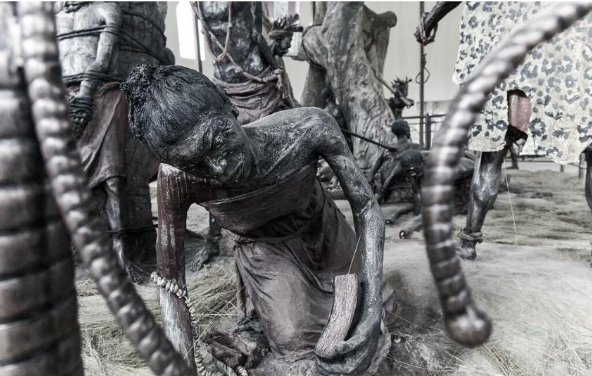
This was the nail in her coffin as Princess Nalumansi was shortly afterwards summoned by the Kabaka to his palace. The King was paranoid that the Christians could easily oust him and crown Princess Nalumansi as Queen of Buganda Kingdom. He dispatched a group of men to bring her before him in his Palace and the mercenaries found her in Kazo Bwaise, but she resisted being dragged before her brother by drawing a gun and firing a bullet into the air. It was during this battle that she was killed by a bullet that one of the men fired in the panic. Princess Nalumansi lost her life in 1888 defending her religion and she was buried near Kazo, Bwaise. A church and school, Emmanuel College Kazo have been constructed near her burial grounds. Recently, Princess Nalumansi’s sculpture was included in the Uganda Martyr’s museum at the Anglican site in Namugongo.
Princess Nalumansi is remembered as the person who warned the missionaries Mackay, R P Ash and O’Flaherty about King Mwanga’s plot to kill them and she advised them to regain favour with the King or leave Buganda before his anger reached them. Her backbone and strength of character enabled her to work to save the missionaries and defend Christianity.
Sarah Nakima converted to Christianity early on and was baptized by Rev R P Ashe O’Flaherty in 1883. She was among the very first group of devout Christians who were captured, tortured and led to Martyrdom at Busega-Mpiima-erebersa in January, 1885. Sarah had recently been widowed and became the single mother of a baby boy, on the day of her arrest she was captured whilst with her baby. Nakima was seized along with three young pages of King Mwanga and marched to slaughter at Busega-Mpiima-erebera where she bravely stood to face death with her fellow Christians.
On the 31st of January, 1885, the men Sarah Nakima was arrested with were Martyred, luckily Sarah was exonerated but her relief was short lived as although she was not Martyred that day, she was tortured and made to attend and witness the burning of her fellow converts, this was done in an attempt to deter her faith but it was unsuccessful. She was later put in stocks, which were feet restraining devices used as a form of corporal punishment and public humiliation. It was Sarah’s belief and faith in God that made her stand firm with those young men and it is this belief that serves to highlight her place in the community of believers at the time.
Sarah Nakima was later on released, considering the delicate and volatile social cultural context of Buganda at the time, a woman with a baby could not be killed, it is rumored that the executioner at Busega-Mpiima-erebera exonerated her because she had a baby.
After the first setoff killings, more and more Baganda continued to convert to Christianity and thus more and more Christians were killed Kabaka Mwanga at Namugongo-Nakiyanja and Namugongo-Bulooli among several other places. For this reason it is not possible to tell the number of Christian women and men who were martyred during that period.
She was the wife of Matia Mulumba and was arrested during the purge of Christians by the Kabaka’s men that went to Mityana looking for Christians. At the time of her arrest, her husband had already been killed at Old Kampala. She was not executed in the same style but rather she as tortured until her death.
These were the sister and mother respectively of Noah Mwagali. They were not executed like Mawagali but they were tortured and consequently died from their injuries. When her son was killed Mmeeme was recorded to have offered herself up for Martyrdom too stating, “If you killed my son because of the faith, please kill me too.”
During the Martyrdom women were made to bear witness to the executions as Kabaka Mwanga thought that if women watched their husbands and brothers being killed then it would deter them from following the ‘New’ religion. Although women were not often killed, they were tortured and subjected to a great deal of abuse as a result of their faith. The fact that women were not Martyred en mass like the men was not due to the fact that they were not willing/ capable of doing so, according to religious scholars the Kabaka is quoted to have ordered, “Don’t kill women, let women see men die, they will soon give up. Don’t kill any white man, don’t. Otherwise, their people back home might come and attack me and disorganize my kingdom”
Although 80% of the church congregations today are women, men have 95% of the key leadership positions. The injustices women face at the hands of religion today undermine the sacrifice that was made by these martyrs, for God doesn’t discriminate against gender. These women inspired other women at the time to convert to Christianity and serve God. Their stories of faith and courage deserves to be recognized and celebrated as Hebrew 12: 1-2 says,
“We are called to stand together with all crowds of witnesses, women and men who trusted God to the end.”

Leave A Comment