Pregnancy and childbirth are processes that are old as humanity; and although immense strides have been taken in advancing medical procedures and care for mothers and babies, childbirth can still be a dangerous and even fatal process for both the mother and the baby. Good maternal health and care remains as one of the most important determinants of the quality of life and health of many women. As such, there is a constant need for the development of procedures and interventions to improve quality of care and ensure maternal and infant health.
The origins of the C-section are unknown, however what is clear is that the procedure has been attempted since the 16th Century and has been improved over time. At the time of development of the C-section, it was rare to have a surgical procedure that was free from infection and where the patients survived and recovered fully. The refinement of the C-section into a safe reliable medical intervention for mothers can therefore be partly credited to the development of
Although many historical accounts favor the Western origins of the procedure, it is also evident that the procedure was also performed in different regions around the world including Sub- Saharan Africa. Most notably, the C-sections were carried out and locally developed in the regions of Bunyoro and Buganda, in Uganda.
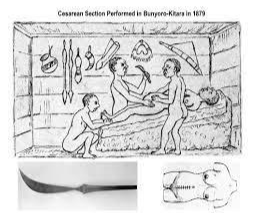
One of the accounts of a C-section being performed in Buganda was recorded in 1879 by Robert Felkin, a medical anthropologist and missionary. Felkin witnessed Baganda surgeons perform the procedure on a 20-year-old mother.
During the procedure, the mother was supplied with banana wine and was in a semi-intoxicated state. She was lying on an inclined bed and was fastened to it by bark-cloth and was also being held by surgical assistants. The surgeon disinfected his hands, the iron knife and the mother’s abdomen with banana wine before the procedure. The surgeon made an incision on the mother’s abdomen and bleeding points were cauterized with a red-hot iron during the surgery. After the delivery of the baby, the surgeon massaged the uterus, removed the blood clots and the placenta. The wound was fastened with iron pins threaded with bark cloth string and dressed with a paste made from roots and covered with a bandage.
From Felkin’s account, the dressing was changed and a few pins removed on the third, fifth and sixth days after the operation. After eleven days the mother’s wound was completely healed without any infection and was able to breastfeed her child. Although this account was recorded in 1879, the precision with which the procedure was conducted pointed to the fact that it had been perfected over time in Buganda. The mother was in minimal pain during the procedure and the risk of infection and over bleeding were managed adequately and her recovery was swift.
1879 is a long way from C-sections as we know them today, however, most of the tools and techniques used in this account of the C-section have equivalents in modern surgical practice. It is clear that local medical and surgical practice was fairly advanced even before the advent of western medicine in Africa.
Leave A Comment